
What Is a Cloud Misconfiguration?
A cloud misconfiguration is any cloud resource setting that deviates from security best practices or organizational policy, creating unintended exposure such as public data access, excessive permissions, disabled encryption, or missing audit logging. Misconfigurations remain the single largest cause of cloud data breaches, with industry analyzes consistently attributing the majority of cloud security incidents to customer-side configuration errors rather than zero-day exploits or provider failures.
Why Misconfigurations Happen
Cloud misconfigurations stem from a fundamental tension: cloud platforms default to flexibility, not security. When a developer creates an S3 bucket, an Azure Storage account, or a GCP Cloud Storage bucket, the platform provides hundreds of configuration options across access control, encryption, networking, logging, and lifecycle management. Each option has a default, and those defaults don't always align with an organization's security posture. Multiply that by thousands of resources deployed across multiple accounts and regions, often by teams with varying levels of cloud security expertise, and misconfigurations become inevitable at scale.
The shared responsibility model compounds this. AWS, Azure, and GCP secure the underlying infrastructure (physical security, hypervisor, network fabric), but the customer owns the configuration of every resource they deploy. A storage bucket is only as secure as the policy attached to it.
Common Misconfigurations by Cloud Provider
AWS
The most exploited AWS misconfigurations include S3 buckets with public access enabled (especially when Block Public Access is disabled at the account level), IAM policies using wildcard actions and resources (Action: *, Resource: *), security groups allowing unrestricted SSH or RDP ingress (0.0.0.0/0 on ports 22 or 3389), EC2 instance metadata service v1 (IMDSv1) enabled, which allows SSRF-based credential theft, and CloudTrail logging disabled or limited to a single region. The Capital One breach of 2019 exploited a misconfigured WAF combined with an overpermissioned IAM role attached to an EC2 instance, allowing the attacker to use SSRF to harvest credentials from the instance metadata service and access over 100 million customer records in S3.
Azure
Azure environments commonly suffer from storage accounts with public blob access enabled, Network Security Groups with overly broad inbound rules, managed identities assigned subscription-level Contributor or Owner roles, Azure AD applications with excessive API permissions (particularly Directory.ReadWrite.All or Application.ReadWrite.All), and diagnostic logging not forwarded to a SIEM. The Microsoft Threat Intelligence team has documented multiple campaigns where attackers exploited misconfigured Azure AD app registrations to establish persistence and move laterally across tenants.
GCP
GCP's most frequent misconfigurations include service account keys downloaded and stored in source code repositories, Cloud Storage buckets with allUsers or allAuthenticatedUsers access, firewall rules with 0.0.0.0/0 source ranges on sensitive ports, and Compute Engine instances running with default service accounts that carry the Editor role. Toyota's 2023 disclosure of a decade-long data exposure traced back to a misconfigured cloud storage environment that left vehicle telemetry data publicly accessible.
Notable Misconfiguration Breaches
Beyond Capital One in 2019 and Toyota's decade-long exposure disclosed in 2023, both noted above, several incidents trace directly to a single configuration mistake.
Accenture, 2017
Researchers found multiple Accenture S3 buckets configured for public access, exposing internal API data, credentials, and certificates. Public bucket access is the first check any posture tool runs, and the fix is a single setting.
Microsoft (BlueBleed), 2022
A misconfigured Azure Blob Storage endpoint left business transaction data belonging to thousands of organizations reachable without authentication. The root cause was a storage endpoint opened to anonymous access, a textbook misconfiguration.
Exposed Databases at Scale
Beyond named brands, tens of thousands of MongoDB, Elasticsearch, and cloud storage instances sit exposed to the internet at any given time with default or absent authentication, routinely discovered by researchers and attackers alike through services like Shodan. Misconfiguration is not a rare event; it is closer to the steady state of the internet.
The Scale of the Problem
NSA and CISA's joint cloud security guidance (published March 2024) highlights misconfiguration and weak security controls among the top risks to cloud environments, alongside recommended mitigations across identity, key management, and network segmentation. Research from multiple CNAPP vendors consistently finds that the average enterprise cloud environment contains hundreds to thousands of misconfigurations at any given time, with a meaningful subset, typically 5 to 10 percent, creating paths to critical data.
The challenge is not eliminating misconfigurations entirely (configuration drift is continuous in dynamic cloud environments) but rather building the detection and response capability to catch exploitable misconfigurations before adversaries do.
Detection and Prevention
Effective misconfiguration management combines preventive controls (infrastructure-as-code scanning with tools like Checkov, tfsec, or Bridgecrew; service control policies and organization policies; deployment guardrails) with detective controls (CSPM platforms, cloud-native services like AWS Config Rules, Azure Policy, and GCP Security Command Center). But tooling alone is insufficient. Practitioners need to understand which misconfigurations are actually exploitable and which represent theoretical risk. That understanding comes from hands-on offensive experience.
Cloud Misconfiguration vs. Software Vulnerability
A software vulnerability is a flaw in code, tracked as a CVE and fixed by patching. A misconfiguration is a flaw in how a correctly functioning service is set up, and there is no patch, only a corrected setting. The distinction matters because the two require different defenses: vulnerability management depends on patch cycles and software inventory, while misconfiguration management depends on posture monitoring, guardrails, and secure defaults. Recent Google Cloud incident data shows software vulnerabilities and credential abuse now account for a larger share of initial access than misconfiguration, but misconfiguration remains a persistent and entirely preventable cause.
Related Labs
Practice discovering and exploiting real misconfigurations in live cloud environments. Pwned Labs scenarios such as Secure S3 with Amazon Macie, Access Secrets with S3 Bucket Versioning, and Breach in the Cloud put you hands-on with the exact settings that cause production breaches. Browse the full set at pwnedlabs.io/explore.
Find and Exploit Real Misconfigurations at Pwned Labs
Pwned Labs provides real cloud environments, not simulated sandboxes, where practitioners discover and exploit the same misconfigurations that cause production breaches. The ACRTP (AWS), MCRTP (Azure), and GCRTP (GCP) bootcamps each walk through provider-specific misconfiguration exploitation, from public storage enumeration to IAM abuse to credential harvesting from metadata services. Practitioners who've exploited a misconfiguration firsthand build the intuition to catch them before attackers do. Start at pwnedlabs.io/bootcamps.
Frequently Asked Questions
What is a cloud misconfiguration?
Any cloud resource setting that deviates from security best practices or organizational policy and creates unintended exposure, such as public storage access, excessive permissions, disabled encryption, or missing logging.
Why are misconfigurations so common?
Cloud platforms default to flexibility over security, expose hundreds of configuration options per service, and are deployed at high velocity across many accounts by teams with varying expertise, so configuration drift is continuous.
Who is responsible for cloud misconfigurations?
The customer. Under the shared responsibility model the provider secures the underlying infrastructure, but the customer owns the configuration of every resource they deploy.
How are misconfigurations detected?
Through Cloud Security Posture Management tools and native services like AWS Config, Azure Policy, and GCP Security Command Center, ideally paired with infrastructure-as-code scanning that catches issues before deployment.
How is a misconfiguration different from a vulnerability?
A vulnerability is a code flaw fixed by patching. A misconfiguration is an insecure setting on correctly functioning software, fixed by changing the configuration, not by applying a patch.
Learn this hands-on in a bootcamp
Train, certify, prove it
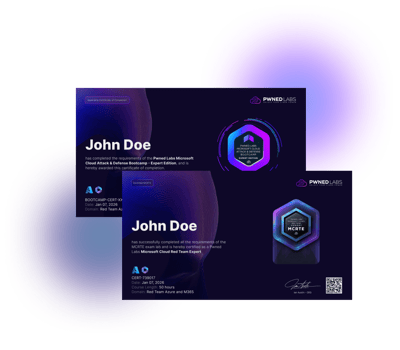
Our bootcamps combine expert-led instruction with real cloud environments. Complete the training, pass the exam, and earn an industry-recognized certification.
What practitioners say.
Caleb Havens
Red Team Operator & Social Engineer, NetSPI
"I’ve attended two training sessions delivered by Pwned Labs: one focused on Microsoft cloud environments and the other on AWS. Both sessions delivered highly relevant content in a clear, approachable manner and were paired with an excellent hands-on lab environment that reinforced key concepts and skills for attacking and defending cloud infrastructures. The training was immediately applicable to real-world work, including Red Team Operations, Social Engineering engagements, Purple Team exercises, and Cloud Penetration Tests. The techniques and insights gained continue to be referenced regularly and have proven invaluable in live operations, helping our customers identify vulnerabilities and strengthen their cloud defenses."
Sebas Guerrero
Senior Security Consultant, Bishop Fox
"The AWS, Azure, and GCP bootcamps helped me get up to speed quickly on how real cloud environments are built and where they tend to break from a security standpoint. They were perfectly structured, with real-world examples that gave me rapid insight into how things can go wrong and how to prevent those issues from happening in practice. I’m now able to run cloud pentests more confidently and quickly spot meaningful vulnerabilities in customers’ cloud infrastructure.”
Dani Schoeffmann
Security Consultant, Pen Test Partners
"I found the Pwned Labs bootcamps well structured and strongly focused on practical application, with clear background on how and why cloud services behave the way they do and how common attack paths become possible. The team demonstrates both sides by walking through attacks and the corresponding defenses, backed by hands-on labs that build confidence using built-in and third-party tools to identify and block threats. The red-team labs are hands-on and challenge-driven, with clear walkthroughs that explain each step and the underlying logic. I’ve seen several of these techniques in real engagements, and the bootcamp helped me develop a repeatable methodology for cloud breach assessments and deliver more tailored mitigation recommendations."
Matt Pardo
Senior Application Security Engineer, Fortune 500 company
"I’ve worked in security for more than 15 years, and every step up came from taking courses and putting the lessons into practice. I’ve attended many trainings over the years, and Pwned Labs’ bootcamps and labs are among the best I’ve experienced. When you factor in how affordable they are, they easily sit at the top of my list. As a highly technical person, I get the most value from structured, hands-on education where theory is immediately reinforced through labs. Having lifetime access to recordings, materials, and training environments means you can repeat the practice as often as needed, which is invaluable. If you’re interested in getting into cloud security, sign up for Pwned Labs.”
Steven Mai
Senior Penetration Tester, Centene
“Although my background was mainly web and network penetration testing, the ACRTP and MCRTP bootcamps gave me a solid foundation in AWS and Azure offensive security. I’m now able to take part in cloud penetration testing engagements and have more informed security discussions with my team.”