
What Is Cloud Security Posture Management (CSPM)?
Cloud Security Posture Management (CSPM) is a category of security tooling that continuously monitors cloud infrastructure across AWS, Azure, and GCP for misconfigurations, compliance violations, and security risks. CSPM platforms work by comparing deployed resource configurations against security best practices, regulatory frameworks, and custom policy baselines, then surfacing prioritized findings that represent real exposure in your environment.
CSPM Defined
Cloud Security Posture Management is a category of security tooling that continuously discovers cloud resources, evaluates their configuration against security and compliance baselines, and surfaces the misconfigurations that create real exposure. Where a vulnerability scanner asks "is this software patched," CSPM asks "is this resource configured safely," across identity, storage, networking, encryption, and logging. It is a detective control: it does not block actions, it tells you where your environment has drifted away from a secure state so you can fix it before an attacker finds the gap.
Why CSPM Became Necessary
Cloud platforms default to flexibility, not security. A single AWS account can hold thousands of resources, each with dozens of configuration options, deployed by many teams at high velocity. Manual review cannot keep pace, and native provider consoles show one account at a time rather than an organization-wide view. CSPM emerged to give security teams continuous, multi-account, multi-cloud visibility into configuration state. According to Gartner, through 2025 99 percent of cloud security failures were expected to be the customer's fault, overwhelmingly due to misconfiguration rather than provider vulnerability. CSPM exists to close exactly that gap.
How CSPM Works
CSPM platforms follow a consistent workflow: discover every resource, assess each against policy, then prioritize what matters.
Discovery
CSPM tools ingest cloud provider APIs to build a real-time inventory of every resource in an environment: compute instances, storage buckets, IAM roles, network configurations, encryption settings, and logging states. Modern platforms like Wiz, Palo Alto Prisma Cloud, and Orca Security extend this with agentless scanning, which inspects workload contents such as installed packages and secrets without deploying agents inside virtual machines or containers.
Assessment
Each resource is evaluated against a library of policies that typically map to frameworks like CIS Benchmarks, SOC 2, PCI DSS, HIPAA, and NIST 800-53. A bucket that allows public reads, a security group open to the internet, or an unencrypted database each trips one or more policy checks.
Prioritization
The core workflow is discover, assess, flag deviations, and present findings ranked by severity. The value of a mature CSPM is not raw detection but prioritization: correlating a finding with internet exposure, data sensitivity, and identity reachability so teams fix the handful of issues that create genuine breach paths rather than drowning in thousands of low-impact alerts.
What CSPM Finds
The misconfigurations CSPM catches are the same ones behind real breaches.
AWS
Common AWS findings include publicly accessible S3 buckets (especially when Block Public Access is disabled at the account level), IAM policies with wildcard permissions (Action: *, Resource: *), unencrypted EBS volumes, security groups allowing unrestricted inbound access on sensitive ports such as 22 and 3389, and CloudTrail logging disabled in secondary regions.
Azure
In Azure, CSPM frequently flags storage accounts with public blob access enabled, Network Security Groups with overly permissive inbound rules, managed identities granted subscription-level Contributor roles, and Key Vault access policies that bypass RBAC.
GCP
GCP findings commonly include service account keys that have not been rotated in over 90 days, Cloud Storage buckets with uniform bucket-level access disabled, and firewall rules allowing 0.0.0.0/0 ingress.
Real-World Misconfiguration Breaches
The exposures below are exactly the kind of configuration failures a CSPM is built to catch.
Capital One, 2019
An attacker exploited a misconfigured web application firewall together with an overpermissioned IAM role attached to an EC2 instance, using server-side request forgery to harvest credentials from the instance metadata service and access more than 100 million customer records stored in S3. A CSPM would have flagged both the overprivileged role and the exposed configuration.
Accenture, 2017
Researchers discovered several Accenture S3 buckets configured for public access, exposing internal credentials, keys, and customer data. Public bucket access is one of the first checks any CSPM runs.
Microsoft, 2022
A misconfigured Azure Blob Storage endpoint, publicly disclosed as BlueBleed, exposed business data belonging to thousands of organizations. The root cause was a storage configuration left open to unauthenticated access, a textbook CSPM finding.
Toyota, 2023
Toyota disclosed that a misconfigured cloud environment had left vehicle and customer data publicly accessible for roughly a decade before it was caught. Continuous posture monitoring exists precisely so an exposure like this does not sit undetected for years.
CSPM vs. CWPP vs. CNAPP
CSPM is one piece of a broader cloud security stack. Cloud Workload Protection Platforms (CWPP) focus on runtime protection of workloads: vulnerability scanning inside virtual machines, container image scanning, and runtime threat detection. CSPM focuses on infrastructure configuration. Cloud-Native Application Protection Platforms (CNAPP) merge both, and often add CIEM, DSPM, and code security, into a single platform. Vendors like Wiz, Prisma Cloud, and Orca all position as CNAPP, but their CSPM modules remain the most widely adopted capability.
Benefits and Limitations
The benefits are continuous multi-cloud visibility, compliance mapping, and early detection of the misconfigurations that cause most cloud breaches. The limitation is that CSPM reports configuration state, not exploitability. It cannot tell you, on its own, that a specific public bucket holds database backups while another serves harmless static assets. That judgment requires understanding how attackers actually chain misconfigurations together, which is where posture management stops and offensive knowledge begins.
From Alert to Action: Why Attack Context Matters
The challenge with CSPM is not detection, it is triage. A mature AWS environment might generate thousands of findings. Teams that lack hands-on understanding of how attackers exploit these misconfigurations struggle to prioritize. Understanding attack chains, how an attacker pivots from an exposed storage account to credential harvesting to lateral movement, turns CSPM from a compliance checkbox into an actionable defense layer. Practitioners who have personally exploited an overpermissioned IAM role or exfiltrated data from a misconfigured storage account make faster, more accurate triage decisions, because they can tell genuine blast radius from noise.
The Shared Responsibility Model and CSPM
CSPM operates entirely within the customer's half of the shared responsibility model. AWS, Azure, and GCP secure the underlying infrastructure, the physical facilities, hypervisor, and network fabric, but the customer owns the configuration of every resource they deploy. A storage bucket is only as secure as the policy attached to it, and no provider will stop a customer from making that policy public. CSPM gives teams continuous assurance over the configuration decisions that are theirs to get right.
Agentless vs. Agent-Based CSPM
Early CSPM relied entirely on API-based configuration reads. Modern platforms add agentless workload scanning, which snapshots disk volumes to inspect installed packages, secrets, and vulnerabilities without installing software inside each workload. Agent-based approaches instead run a lightweight process inside the workload for deeper runtime visibility, at the cost of deployment overhead. Most enterprises favor agentless coverage for breadth and reserve agents for the highest-value workloads. The tradeoff matters, because agentless scanning can miss in-memory activity that only a runtime agent would see.
Shifting CSPM Left into CI/CD
Posture management increasingly extends into the development pipeline. By scanning infrastructure-as-code such as Terraform, CloudFormation, and ARM templates with tools like Checkov and tfsec before deployment, teams catch misconfigurations as pull requests rather than as production findings. This shift-left approach reduces the volume of runtime alerts CSPM has to raise, because fewer bad configurations ever reach the cloud. The strongest programs pair pre-deployment scanning with continuous runtime posture monitoring, so configuration drift introduced after deployment is still caught.
Operationalizing CSPM
Deploying CSPM is the easy part. The operational challenge is turning findings into fixes without overwhelming engineering teams. Effective programs route findings to the owning team automatically, suppress accepted risks with documented exceptions, enforce guardrails through service control policies and Azure Policy so the worst misconfigurations cannot be deployed in the first place, and track mean time to remediation as a core metric. A CSPM that only generates a dashboard nobody actions provides a false sense of security.
Related Labs
Practice the attacks behind common CSPM findings in real cloud environments. Relevant Pwned Labs scenarios include Secure S3 with Amazon Macie, Access Secrets with S3 Bucket Versioning, and Breach in the Cloud, which covers S3 enumeration and detecting the resulting activity in CloudTrail. Browse the full set at pwnedlabs.io/explore.
Learn the Attacks CSPM Detects at Pwned Labs
Pwned Labs bootcamps teach practitioners to exploit the exact misconfigurations that CSPM tools flag, then build detections for them. The MCRTP (Azure) and ACRTP (AWS) bootcamps cover public storage exposure, IAM privilege escalation, and credential harvesting in real cloud environments, not sandboxed simulations. When you have manually exploited a misconfiguration, you understand why the CSPM alert matters and how to prioritize the response. Explore the bootcamps at pwnedlabs.io/bootcamps.
Frequently Asked Questions
What is the primary purpose of CSPM?
To continuously monitor cloud infrastructure configuration across AWS, Azure, and GCP, and to surface misconfigurations and compliance violations that create exposure, so teams can fix them before attackers exploit them.
How is CSPM different from a vulnerability scanner?
A vulnerability scanner checks whether software is patched. CSPM checks whether cloud resources are configured securely, evaluating identity, storage, networking, encryption, and logging settings against best-practice and compliance baselines.
Does CSPM protect running workloads?
Not directly. CSPM focuses on infrastructure configuration. Runtime workload protection is the domain of CWPP, and CNAPP platforms combine both capabilities.
Which compliance frameworks does CSPM map to?
Most CSPM platforms map findings to frameworks such as CIS Benchmarks, SOC 2, PCI DSS, HIPAA, and NIST 800-53, which is why CSPM is often used for continuous compliance reporting.
Why do teams still get breached if they run CSPM?
Because CSPM reports configuration state, not exploitability. Without the offensive context to prioritize which findings represent real attack paths, teams can miss the handful of issues that matter among thousands of alerts.
Learn this hands-on in a bootcamp
Train, certify, prove it
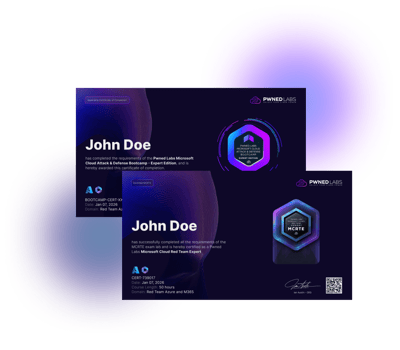
Our bootcamps combine expert-led instruction with real cloud environments. Complete the training, pass the exam, and earn an industry-recognized certification.
What practitioners say.
Caleb Havens
Red Team Operator & Social Engineer, NetSPI
"I’ve attended two training sessions delivered by Pwned Labs: one focused on Microsoft cloud environments and the other on AWS. Both sessions delivered highly relevant content in a clear, approachable manner and were paired with an excellent hands-on lab environment that reinforced key concepts and skills for attacking and defending cloud infrastructures. The training was immediately applicable to real-world work, including Red Team Operations, Social Engineering engagements, Purple Team exercises, and Cloud Penetration Tests. The techniques and insights gained continue to be referenced regularly and have proven invaluable in live operations, helping our customers identify vulnerabilities and strengthen their cloud defenses."
Sebas Guerrero
Senior Security Consultant, Bishop Fox
"The AWS, Azure, and GCP bootcamps helped me get up to speed quickly on how real cloud environments are built and where they tend to break from a security standpoint. They were perfectly structured, with real-world examples that gave me rapid insight into how things can go wrong and how to prevent those issues from happening in practice. I’m now able to run cloud pentests more confidently and quickly spot meaningful vulnerabilities in customers’ cloud infrastructure.”
Dani Schoeffmann
Security Consultant, Pen Test Partners
"I found the Pwned Labs bootcamps well structured and strongly focused on practical application, with clear background on how and why cloud services behave the way they do and how common attack paths become possible. The team demonstrates both sides by walking through attacks and the corresponding defenses, backed by hands-on labs that build confidence using built-in and third-party tools to identify and block threats. The red-team labs are hands-on and challenge-driven, with clear walkthroughs that explain each step and the underlying logic. I’ve seen several of these techniques in real engagements, and the bootcamp helped me develop a repeatable methodology for cloud breach assessments and deliver more tailored mitigation recommendations."
Matt Pardo
Senior Application Security Engineer, Fortune 500 company
"I’ve worked in security for more than 15 years, and every step up came from taking courses and putting the lessons into practice. I’ve attended many trainings over the years, and Pwned Labs’ bootcamps and labs are among the best I’ve experienced. When you factor in how affordable they are, they easily sit at the top of my list. As a highly technical person, I get the most value from structured, hands-on education where theory is immediately reinforced through labs. Having lifetime access to recordings, materials, and training environments means you can repeat the practice as often as needed, which is invaluable. If you’re interested in getting into cloud security, sign up for Pwned Labs.”
Steven Mai
Senior Penetration Tester, Centene
“Although my background was mainly web and network penetration testing, the ACRTP and MCRTP bootcamps gave me a solid foundation in AWS and Azure offensive security. I’m now able to take part in cloud penetration testing engagements and have more informed security discussions with my team.”