
AI Systems Red Team Certification
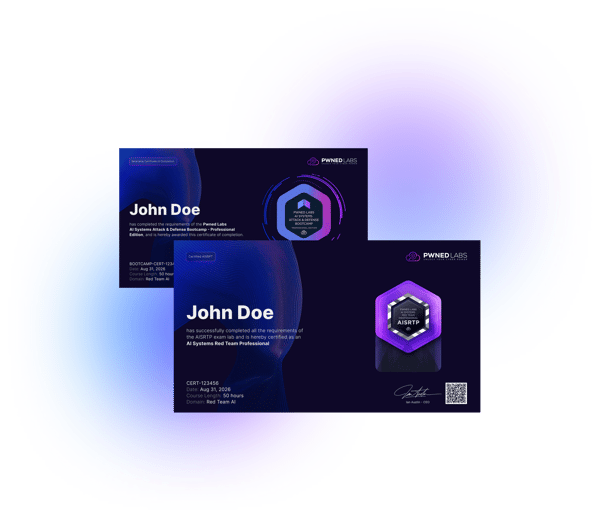
AI Systems Red Team Certification at a glance
- Full name: AI Systems Red Team Professional (AISRTP)
- Format: Hands-on, assessed in a live AI and agentic environment
- Focus: prompt injection, RAG and embedding poisoning, and agentic and MCP attacks
- Level: Professional
- Prerequisites: a general security foundation (no prior AI security experience required)
- Delivered via: the AI Systems Attack and Defense bootcamp
The AI Systems Red Team Professional (AISRTP) is a hands-on AI Systems red team certification, earned through the AI Systems Attack and Defense bootcamp, an on-demand Pwned Labs program that goes deep on modern attack chains and the detections that catch them, then certifies you hands-on.
AI systems are a new and fast-moving attack surface, which is exactly why attackers are drawn to them. LLM applications, RAG pipelines, and agentic systems behave unlike traditional apps, and the trust boundary moves in ways defenders rarely model, so injection and excessive-agency paths go unnoticed. An AI red team certification should prove you can find and exploit them in a live environment. The AI Systems Red Team Professional (AISRTP) is built to do that, hands-on.
What the AISRTP certification proves
AISRTP is a practical AI and agentic red team certification. There is no multiple choice section. You are assessed inside a live environment of LLM-backed and agentic applications with realistic weaknesses and telemetry, and you have to reach the objective through a working exploitation chain across direct or indirect prompt injection, RAG or tool abuse, and excessive agency in connected systems. Passing means you demonstrated real tradecraft against real AI infrastructure, which is a credential an employer can trust.
Who this certification is for
AISRTP fits application security engineers, penetration testers, and red teamers moving into AI, and the developers and detection engineers who build and defend LLM-backed features. You do not need prior AI security experience. The AI Systems Attack and Defense bootcamp that leads into AISRTP starts from how these systems are built and where they break, then progresses into prompt injection, RAG poisoning, and agentic and MCP attack paths, so a strong general security background is enough to start.
What you learn on the path to AISRTP
The curriculum tracks how AI and agentic systems are actually compromised rather than listing model features. Core areas include:
- Direct and indirect prompt injection in shipped LLM applications, including turning retrieved or user-supplied content into attacker-controlled instructions.
- Poisoning retrieval-augmented generation across documents, tickets, wikis, and embedding stores, and making retrieval attacks reliable.
- Finding tool-abuse and excessive-agency paths in agentic systems, and tracing compromise across CI/CD agents and MCP-connected tool servers.
- Detecting AI attacks in telemetry: prompts, tool calls, retrieval hits, and side effects.
- Applying the same tradecraft across AWS Bedrock, Azure AI Foundry, Google Vertex AI, and self-hosted stacks.
Because the labs run against realistic LLM-backed and agentic applications, you build the blue team awareness that distinguishes an AI red teamer from someone who only ran a script.
AISRTP compared to other AI security training
Most AI security training is conceptual or governance-focused. It explains model risks and responsible-AI principles, which is valuable for policy and design, but it does not ask you to attack a running system. Broad application security certifications prove general skill while covering little of the prompt injection, retrieval, and agentic abuse that defines AI compromise. AISRTP fills that gap with a fully hands-on, offense-focused assessment against live AI and agentic systems.
How the AISRTP exam works
The certification is assessed in a live environment of AI and agentic applications, not a simulation. You are given objectives and a time window and must accomplish them with real tradecraft against real systems that are logging your activity. There is no memorization component. You reach the objectives or you do not, which makes the credential difficult to fake and easy for an employer to verify.
Inside the AISRTP exam environment
The exam is a single realistic scenario, not a question bank. You get 24 hours and an entry point into a live set of LLM-backed and agentic applications, then build a complete exploitation chain from that foothold to the flag. The applications, the weaknesses, and the telemetry are all real.
It is self-contained and unproctored, so there is nothing external to bring and no screen recording. Because it is a chain rather than isolated tasks, partial knowledge shows, and there is no pentest report to write. You capture the flag or you do not, which makes the credential easy for a hiring manager to read.
Preparing for the AISRTP exam
You do not need prior AI security experience to start. What you do need is comfort with HTTP, reading JSON, and the command line, and a general security foundation. Familiarity with Python or curl helps, but the bootcamp opens with how LLM-backed and agentic systems are built before moving into the advanced material, so the ramp is built into the path.
AISRTP sits within our broader AI security training, which spans AI red teaming, LLM security, and AI penetration testing.
Frequently asked questions
What does AISRTP stand for?
AISRTP stands for AI Systems Red Team Professional. It is the hands-on certification earned through the AI Systems Attack and Defense bootcamp at Pwned Labs.
Is AISRTP a hands-on certification?
Yes. AISRTP is assessed in a live environment of LLM-backed and agentic applications with realistic weaknesses and telemetry. There is no multiple choice component.
Do I need AI security experience before starting?
No prior AI security experience is required. The bootcamp starts with how LLM and agentic systems are built and where they break, then builds toward prompt injection, RAG poisoning, and agentic attacks. A general security foundation is enough.
How is AISRTP different from other AI security courses?
Most AI security training is conceptual or governance-focused. AISRTP is an offensive, fully practical certification earned by operating against live AI and agentic systems. They serve different, complementary goals.
Does AISRTP cover agentic systems and MCP?
Yes. The curriculum covers tool-abuse and excessive-agency paths in agentic systems, and tracing compromise across CI/CD agents and MCP-connected tool servers.
What roles does AISRTP support?
Application security engineer, penetration tester, red teamer, and detection engineer roles where proving offensive AI capability matters.
What practitioners say.
Dani Schoeffmann
Security Consultant, Pen Test Partners
"I found the Pwned Labs bootcamps well structured and strongly focused on practical application, with clear background on how and why cloud services behave the way they do and how common attack paths become possible. The team demonstrates both sides by walking through attacks and the corresponding defenses, backed by hands-on labs that build confidence using built-in and third-party tools to identify and block threats. The red-team labs are hands-on and challenge-driven, with clear walkthroughs that explain each step and the underlying logic. I’ve seen several of these techniques in real engagements, and the bootcamp helped me develop a repeatable methodology for cloud breach assessments and deliver more tailored mitigation recommendations."
Matt Pardo
Senior Application Security Engineer, Fortune 500 company
"I’ve worked in security for more than 15 years, and every step up came from taking courses and putting the lessons into practice. I’ve attended many trainings over the years, and Pwned Labs’ bootcamps and labs are among the best I’ve experienced. When you factor in how affordable they are, they easily sit at the top of my list. As a highly technical person, I get the most value from structured, hands-on education where theory is immediately reinforced through labs. Having lifetime access to recordings, materials, and training environments means you can repeat the practice as often as needed, which is invaluable. If you’re interested in getting into cloud security, sign up for Pwned Labs.”